01 / Why birds get priority
Birds turn
attention into instinct.
One of a cat’s most compelling activities is waiting for the moment to pounce, and birds make especially strong targets. They move quickly and unpredictably, turning every second into something worth tracking.
When a cat watches a bird through a window—perhaps at a feeder—the bird’s calls, chirps, wingbeats, and rustling create a layered soundscape around the movement. Those signals pull the cat’s natural hunting attention toward the glass. For a moment, the bird can outrank ordinary household distractions: a toy, a bowl of food, or even the person the cat was just bothering.
This response is not simply about being hungry. The bird’s movement and sound provide instinctive stimulation, activating the desire to watch, follow, calculate, and possibly chase. The attraction is the hunting opportunity itself.
02 / How cats recognize birds
More than
a moving shape.
A cat can read a bird through more than sight. Motion gives it a target to follow, while distance and direction help it understand where that target is going and whether it could reach it.
Sound adds another layer. Wingbeats, chirps, calls, and rustling can reveal a bird’s presence even when the cat cannot see every movement clearly. As the cat gets closer, its whiskers and body position help it judge the space around its face and paws, refining how near the target is and whether the distance can be covered.
These signals work together. The cat is not relying on eyesight alone; it is combining motion, sound, direction, distance, and body feedback before deciding whether a pounce is possible.
- 01Motion
What moved?
- 02Sound
Where did it come from?
- 03Distance
Can the gap be covered?
- 04Direction
Where will it be next?
03 / Before the pounce
Before the pounce,
the body goes quiet.
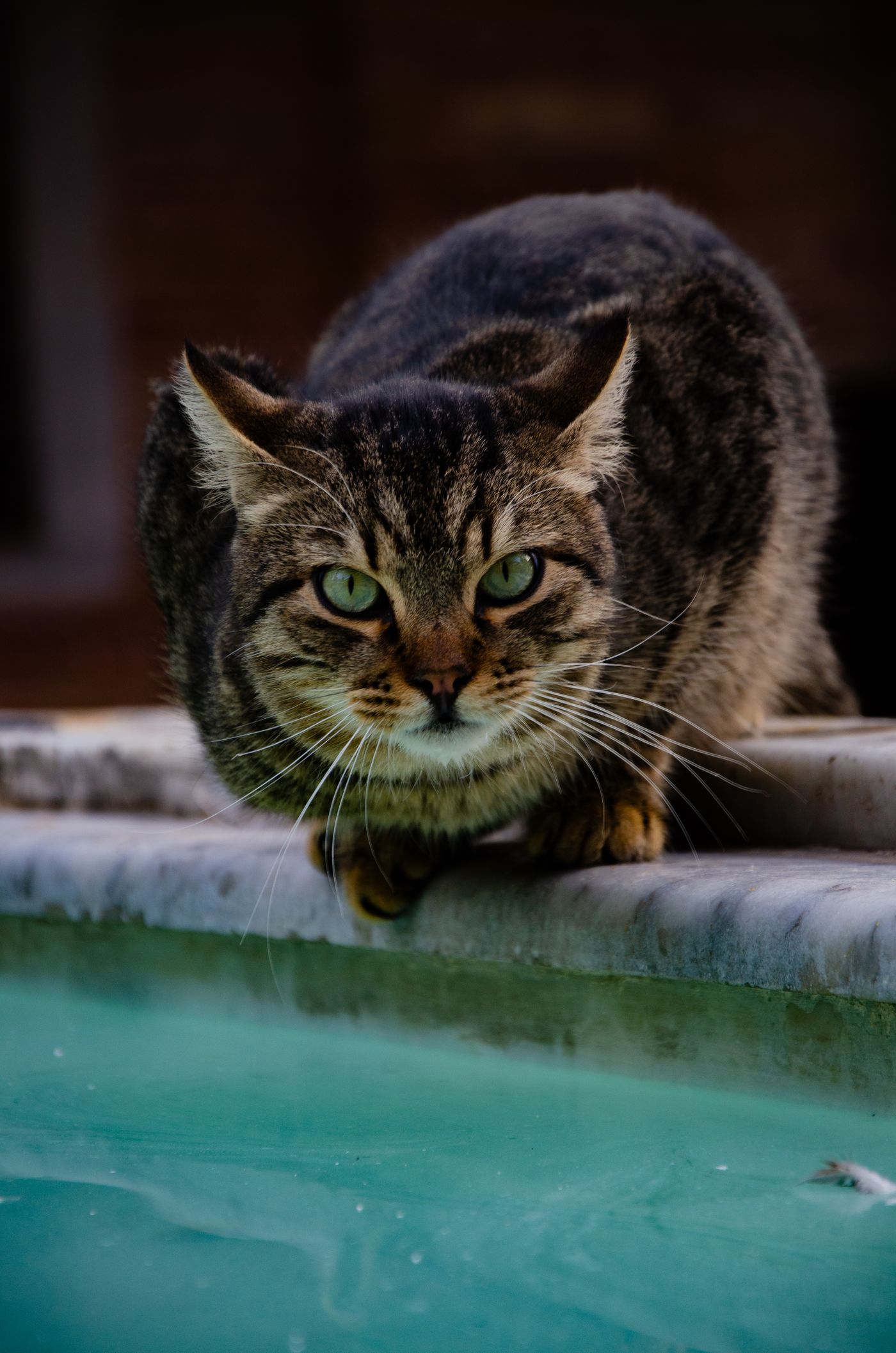
First, the cat’s eyes lock onto the target. Its head and ears turn toward the movement or sound, narrowing its attention until almost nothing else matters.
Then the body slows down and becomes deliberate. The shoulders lower, the weight shifts back, and the hind legs coil so they can drive the cat forward when the distance is right.
The tail goes still and stays close to the body, cutting down on unnecessary movement. It is less a conscious plan for camouflage than a quieting of the whole body—one last pause before motion takes over.
05 / What indoor cats can do with that instinct
Give the instinct
a safe outlet.
Indoor play can give a cat the same sequence it is rehearsing at the window without sending it outside. Use a wand toy that moves like a small bird or another piece of prey, changing direction so the cat has to watch, follow, and adjust.
Bring different toys into the routine instead of leaving every option out all the time. Novelty keeps an old toy interesting.
Treat puzzles and food toys make the cat work through searching, reaching, and solving—not just batting at a moving object.
Check out our puzzles ↗Let the cat stalk, chase, catch, and complete the play with its toy. The ending matters as much as the chase.
Keep the outlet indoors. A free-roaming cat can become a highly effective hunter, putting pressure on wildlife and taking more risks outside than it needs to take during play.
06 / Main takeaway
The pounce is
the final step.
A cat is not simply staring at a bird. It is gathering visual, auditory, and environmental information, then using movement, distance, and balance to make a final decision. The pounce is the end of a longer process of tracking, calculating, and waiting.